
Results of the 2025–2026 academic year monitoring for the "Physical Culture" educational program
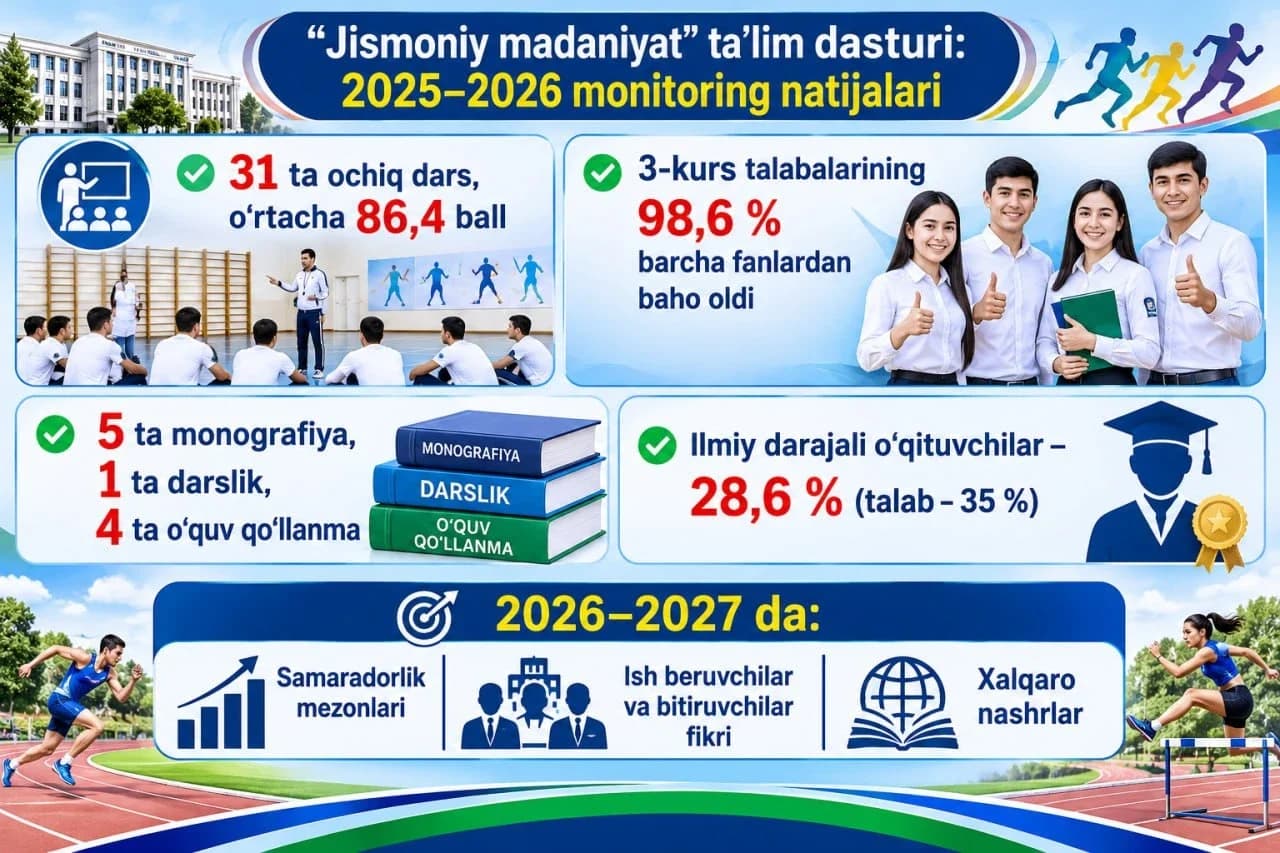
The Department of Theory and Methodology of Physical Culture of the Gulistan State Pedagogical Institute announces the results of the annual monitoring of the 60111200 – "Physical Culture" bachelor's degree program for the 2025–2026 academic year. The monitoring was conducted based on the Institute's "Quality Assurance Policy within the Educational Program," and the report was discussed and approved at the department's meeting No. 11 on June 24, 2026.
How the monitoring was conducted
The monitoring utilized analysis of learning outcomes (HEMIS records), observation of open classes and evaluation using the Institute's form, the department's annual report, minutes of department meetings, and data comparing performance with the 2024–2025 academic year.
Educational process
- The department completed a teaching load of 18,314 hours across 11 subjects.
- The planned 31 open classes were fully conducted (16 in the autumn semester, 15 in the spring semester). Each class was evaluated using the Institute's form, with an average score of 86.4 (80–92). Each open class was discussed at the department meeting.
- In the spring semester, 306 students took final exams in 11 subjects, with no failing grades recorded. Students who received grades in all subjects: 88.3% in the 2nd year (144 out of 163), 98.6% in the 3rd year (141 out of 143).
Faculty composition
- Full-time faculty members – 14 out of 19 (73.7%).
- Faculty members with scientific degrees – 28.6% of the full-time staff (4 people).
- 10 teachers completed professional development (last year – 5), senior teacher O'.Eshonqulov defended a PhD dissertation, and 2 teachers hold a foreign language certificate.
Scientific and methodological activity
- 5 monographs, 1 textbook, and 4 study guides were published.
- 21 articles were published in local journals, 15 articles in foreign journals, and 47 conference abstracts were published.
Strengths
- The open class plan was fully completed for two consecutive academic years.
- The number of publications increased: monographs from 1 to 5, study guides from 1 to 4.
- The number of teachers who completed professional development doubled.
- Almost all 3rd-year students fully mastered the subjects.
Areas requiring improvement
- The share of faculty members with scientific degrees (28.6%) is below the required 35%.
- There are no articles in Web of Science and Scopus journals, grant projects, or cooperation memoranda with foreign universities.
- Opinions of employers and graduates are not studied systematically.
- In the 2nd year, 19 students did not receive a grade in at least one subject.
- A system of unified indicators measuring program effectiveness has not yet been introduced.
Measures to be implemented in the 2026–2027 academic year
- Development of criteria for evaluating the effectiveness of the educational program (with norms and target values) and introduction of a unified monitoring schedule.
- Determining the employment of 2026 graduates, discussing their needs and suggestions with employers.
- Analyzing the results of student surveys in the context of the program at the department level.
- Introducing semester reports for subjects, creating a retake schedule for students with debts.
- Increasing the share of faculty members with scientific degrees to at least 35%.
- Publishing at least 2 articles in Web of Science / Scopus journals, applying for grant competitions, and signing a memorandum with a foreign university.
You can send your suggestions and opinions regarding the monitoring results to the Department of Theory and Methodology of Physical Culture or via the Institute's official Telegram channel. The next annual monitoring report will be published in June 2027.